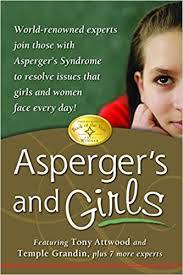
Asperger’s and Girls is a book with nine chapters from different autism experts, some of whom are autistic themselves, about various aspects of Asperger’s as it relates to females. It was published in 2006 and I’m sure was groundbreaking at the time, as we are still seeing the need for education about the incidence and experience of females with Asperger’s today.
The first few chapters deal with the issue of under-diagnosis of Asperger’s in females and discuss the need for programming and services designed specifically for this population. Tony Attwood, a clinical psychologist from Australia and prominent author and speaker about autism, starts off the book by talking about the ways that females can present differently from males. I appreciate him speaking out about this so much; in fact, it was at a conference where he spoke about autism in females that I first suspected I was autistic. He is followed by Catherine Faherty talking about starting a women’s group in her area and by Sheila Wagner talking about the needs of girls in the educational system.
Chapter Four is about fitting in and having friends, as well as bullying, primarily during the teenage years. While there is a lot of good information about typical peer structures, the focus is exclusively on how a girl can adapt to fit in with typical peers, rather than accepting herself as she is and finding friends who can accept her as well.
There is a chapter on puberty that has some good information and advice to parents and educators on how to help girls prepare for that time in their life, as well as a chapter about the transition from high school to adulthood which stresses the needs for parents to guide without being overprotective.
By far my favorite chapter is the one on dating, relationships, and marriage. Written by Jennifer McIlwee Myers, who has Asperger’s, it promotes being comfortable with yourself and looking for a partner who will accept you for who you are. As she puts it,
You don’t find your one true love by being fake; you find him by living your life and being the best version of you that you can achieve. A girl or woman with AS isn’t going to find her best life by trying to be neurotypical, but rather by striving to the the best darn Aspie she is able to be.
This is one of the longer chapters in the book and is full of great advice and encouragement.
Chapter Eight is the story of an autistic woman detailing her experiences with motherhood. She has a total of four children, two of whom are autistic. Her story is one of gradual discovery and understanding as she learns to support and advocate for her children.
The book ends somewhat abruptly with a short chapter by Temple Grandin talking about her choice to focus on her career and not pursue any sort of dating or romantic relationships. She explains that this is because of the way she is wired and that other people may wish for different things in their lives, but says she is happy and fulfilled by her solitary life.
All in all, this was a good read with some valuable information about Asperger’s in girls and women. I would definitely recommend it.


 In So Many Words